Posts

Youth And Climate II

Image
  Youth form an integral part of the fight against climate change. As a matter of fact, it is impossible for climate action to be successful without involving young people as the most important stakeholders. They are so because climate change has consequences on both their present and future. In other words, in an already changing climate regime, young people have to deal with the impacts on their lives presently, and in the future; their lives are at stake too. Young people also happen to be one of the most vocal constituencies in climate action, with all ages from children, adolescents to young adults expressing their commitment to pressure their leaders; both political and industry leaders; the private sector and all decision makers to act on climate. Currently, it is estimated that youth are about 1.8 billion globally, though actual figures are higher. The two biggest continents, Asia and Africa which are also the most populous, also host the youngest populations on Earth. ...

The Glasgow Pact

Image
  The Glasgow Pact was an agreement signed by 197 countries in November of 2021 in Glasgow, Scotland under the leadership of the United Kingdom/Italy. This event took place under the auspices of COP26, the international meeting of parties to the UNFCCC, which takes place each year. This conference was well awaited and with good reason: it was postponed from 2020 to 2021 and was a crucial one because all nations were to submit fresh climate plans showing increased ambition to cut emissions. These plans, called nationally determined contributions, were initially submitted in 2015 when the Paris Agreement was signed, and are meant to be upgraded every five years. This particular meet was important because the decade ending 2030 is of grave significance to climate change. We have a slight window within which to act, if at all we are to save this planet from extreme climatic changes, and keep alive and thriving the intentions of the Paris agreement 2015. The global carbon budget is ...

Indigenous People And Climate Change

Image
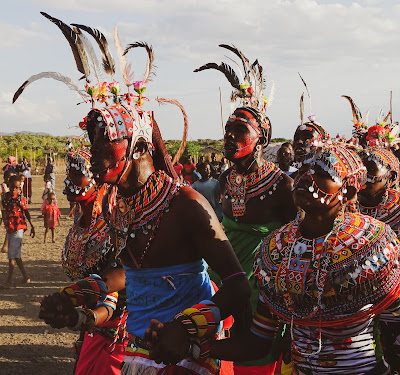
  Indigenous people are peoples who are native to a particular geographical area and have lived there for a long time frame (decades to centuries) before the arrival of other migratory peoples bent on conquest. Indigenous people can trace their ancestral heritage to a particular region which they have occupied for a very long time. There are more than 476 million indigenous people in the world today. They are about 5% of the Earth’s population but constitute 15% of its poorest. However 22% of the Earth’s surface is under their management and 80% of the Earth’s natural wild flora and fauna, its biodiversity, is also in indigenous territories. The colourful Samburu community of Kenya. Source laura/iwaria With regard to climate change, indigenous peoples are important because they are a vital component in the climate fight. They are also a unique group of people who are differently affected by human caused climatic changes. We look at a few reasons why. Indigenous people are spe...

Peatlands And Climate Change

Image
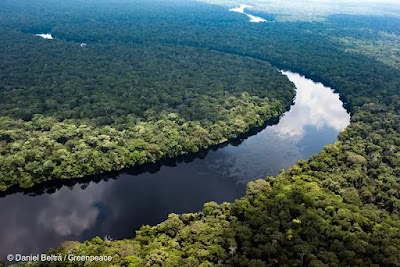
Peatlands are a type of organic soil that is very rich in carbon. Peat soils are dark in colour and are formed from accumulation of hundreds to thousands years of undecomposed remains of plants and other organic matter. These lands in particular are a combination of peat soils covered by water. They are therefore peat wetlands or peatlands in short. These wetlands occur almost everywhere on the planet, from tropical to temperate regions. Almost every country globally has peat in one form or another. Peatlands cover 3% of the planet but are so rich in carbon that they host almost a third or 30% of all soil carbon with slightly more than half a trillion tons of carbon. This makes them the biggest land-based reservoirs of carbon ahead of forests (twice bigger). Peatlands vary widely, and consist of mires and bogs, waterlogged soil, fens and swamps to forest peat. An example of forest peat is the vast stores of peat found underneath the Congo Forest which is the second largest forest n...

Mangroves And Climate Change

Image
  Mangroves are coastal forests found at the border between land and sea. They are also found at river mouths (estuaries). Half their acreage is in the land and some parts are in the sea. Mangroves form the blue carbon ecosystems of which sea grass and saltmarshes are the others. As an ecosystem, mangroves are very rich in terms of biodiversity and carbon stores. Mangroves house thousands varying and multiple species of animal life and fish, and over 80 plant species. Mangoves are located in 123 nations and are found ringing the Indian Ocean and sections of Atlantic and Pacific Oceans. Research figures put their coverage to about 152,000 square kilometers globally. Mangroves are unique in many ways, because even though they are below 1 percent of tropical forests, they are faster and more effective at carbon storage. It is estimated that the soils beneath mangrove forests carry about 6.4 billion tonnes of locked carbon, spread at the rate of a thousand tons per hectare. Majorit...

Coral Bleaching And Climate Change

Image
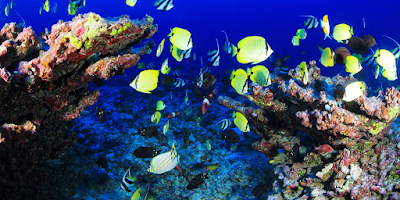
  Coral is a marine organism found beneath the sea on the floor. It is found near coastal areas and is popularly known as coral reefs. Coral reefs are the abundance of skeletons of this marine organisms, who living in colonies, have been built up into formidable amounts over time. Coral is found in the first hundred meters of the sea and spreads over a region of about 284,000 square kilometers globally. Coral does not do very well (except deep sea coral) in extremely cold waters and so the large majority is found in the warm waters of tropical seas. Examples of coral reefs include the Watamu, Mombasa, Malindi, Wasini coral reefs that line up the entire Kenyan Coast off the Indian Ocean, . A part of Watamu coral reef - source (AmboseliParkKenya.com) Coral reefs are made up of two distinct creatures. The coral polyps and the algae. Polyps are the main invertebrate ‘animals’ whose formidable build up is visible while the algae are tiny microscopic creatures that give the coral i...

Buildings And Climate Change

Image
  Buildings in the modern world are mainly made of concrete and steel, which are heavy carbon intensive industries. Buildings use 36% of energy and account for 39% percent of greenhouse gas emissions from energy. There are three major ways that buildings contribute to emissions of carbon. The first is the “initial carbon”. This are the emissions released from disturbing the soil, they are part of soil carbon as well as the carbon from the vegetation cleared. This is done when the site is being prepared and dug up for construction to commence. This carbon is released into the atmosphere. The second type is embodied carbon, and this is the carbon dioxide produced in the preparation of construction materials. By this, I refer to cement and concrete, steel, aluminum, glass, mortar, and synthetic materials commonly used to erect a building. All the above, but especially cement, concrete and steel have an extra-large carbon footprint. The chemical processes and energy used to produ...